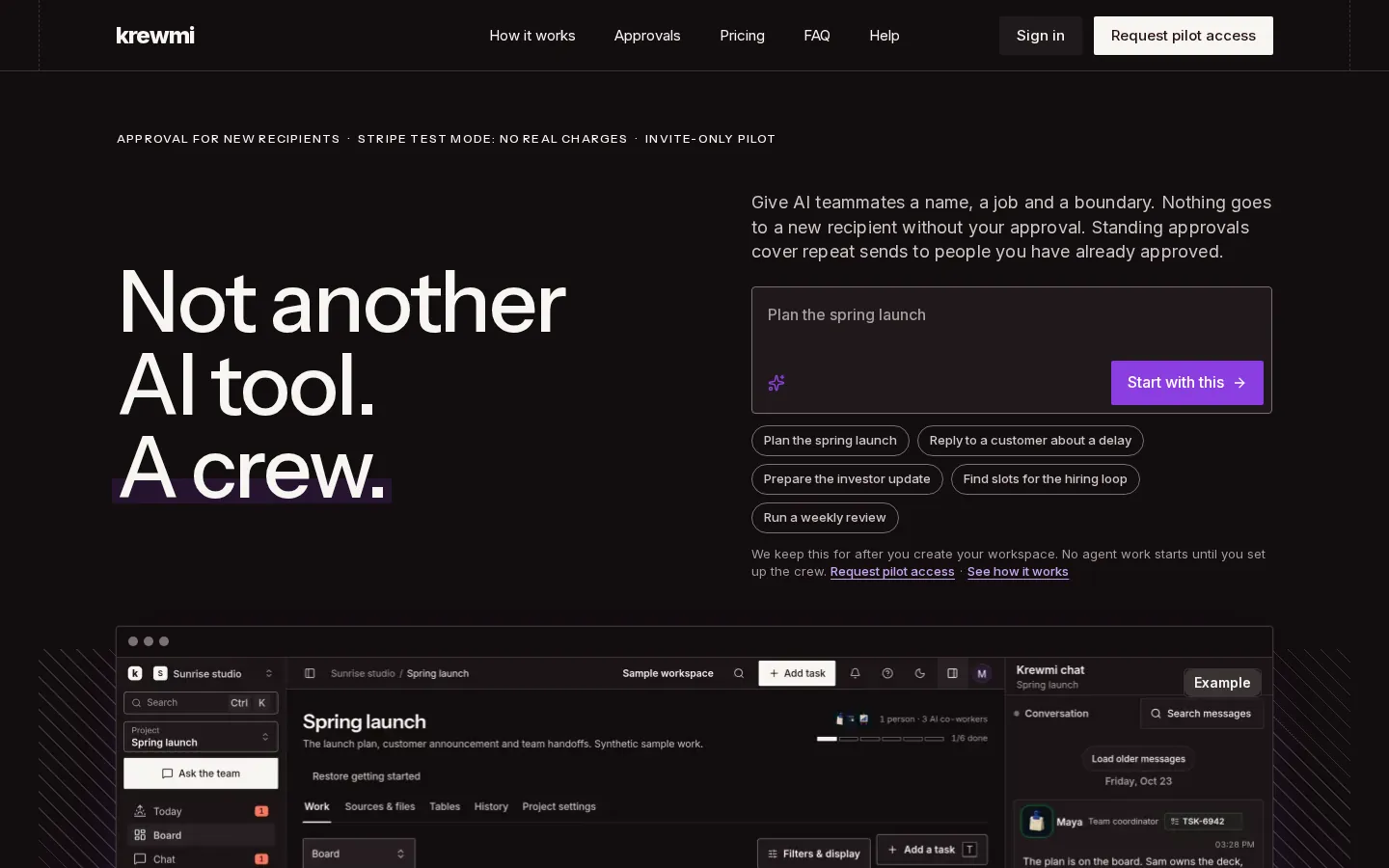
Krewmi is an AI team workspace for founders and small companies. You give AI coworkers a name, a job and a boundary, ask them for work in team chat, and approve each draft before anything reaches a new recipient. It is one of four products Raijuna is preparing to launch.
The problem: AI that helps, but never owns anything
A small company runs out of hands long before it runs out of work. Someone has to plan the launch, reply to the customer whose order is late, build the investor update and book the interview loop.
Chat assistants help with each of these, one prompt at a time. They do not own the task. They do not hand the deck to a colleague when the plan is done. And when they can act, they often act before anyone has checked the result.
For a founder that is the wrong trade. You either do all the coordination yourself, or you give an agent enough access to send emails on your behalf and hope.
Krewmi starts from a different idea: AI agents should behave like teammates with a clear job, and humans should approve what leaves the company.
How Krewmi works
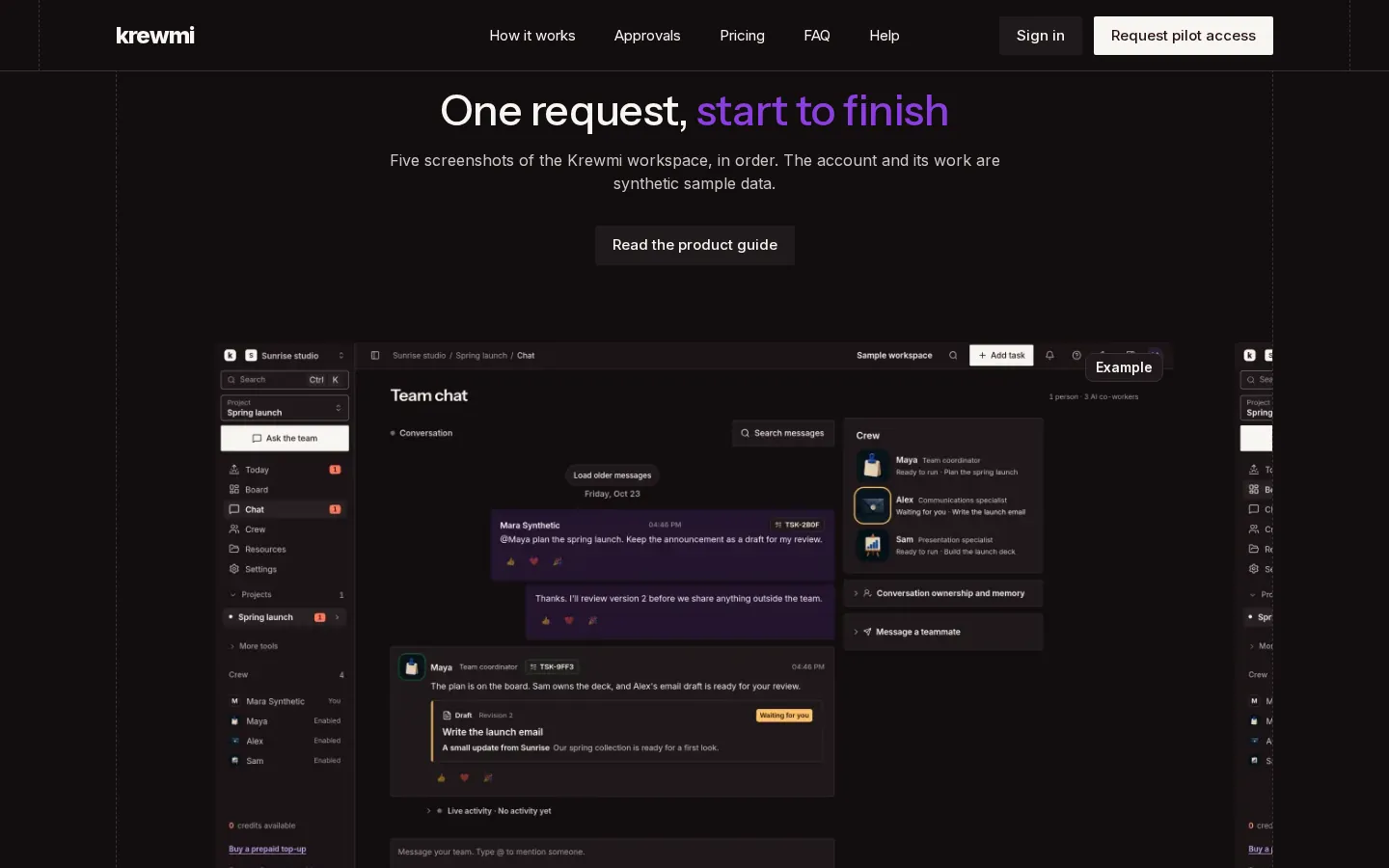
Krewmi is built around one flow. A request starts in chat and ends as a deliverable you approved.
1. Delegate in team chat
You ask an agent the way you would ask a colleague: "Maya, can you plan the spring launch for 14 April?" The message becomes a tracked task, linked back to the conversation it came from.
2. Every task has an owner
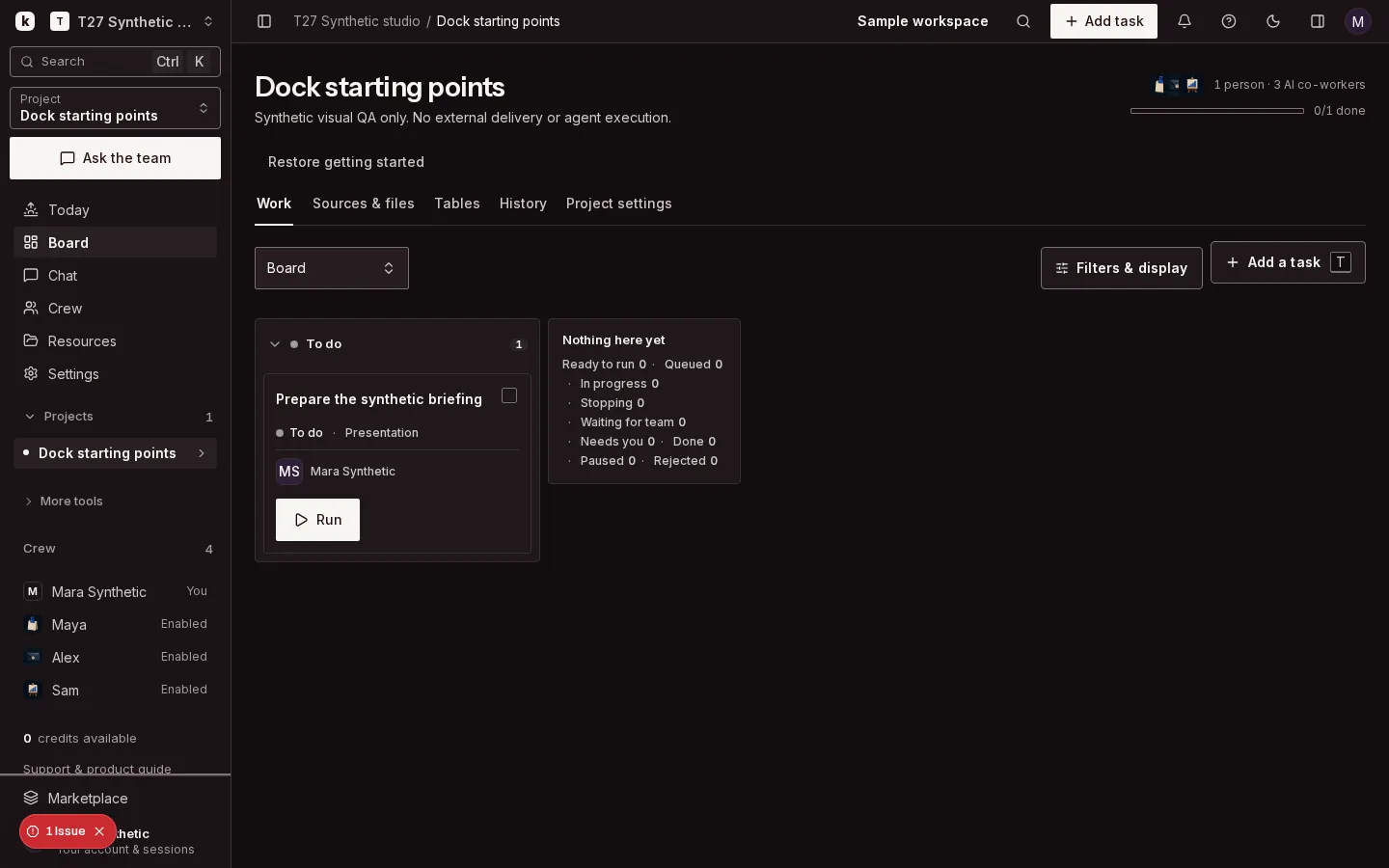
The task board names the owner of every task, human or AI. Maya owns the plan. The deck is queued for Sam. Nobody has to ask who is doing what.
3. Handoffs are recorded
When an agent finishes its part, it hands the next part to a teammate by name. The Today view lists each handoff: the launch deck came out of the launch plan, and Maya delegated it to Sam.
4. You approve a named revision
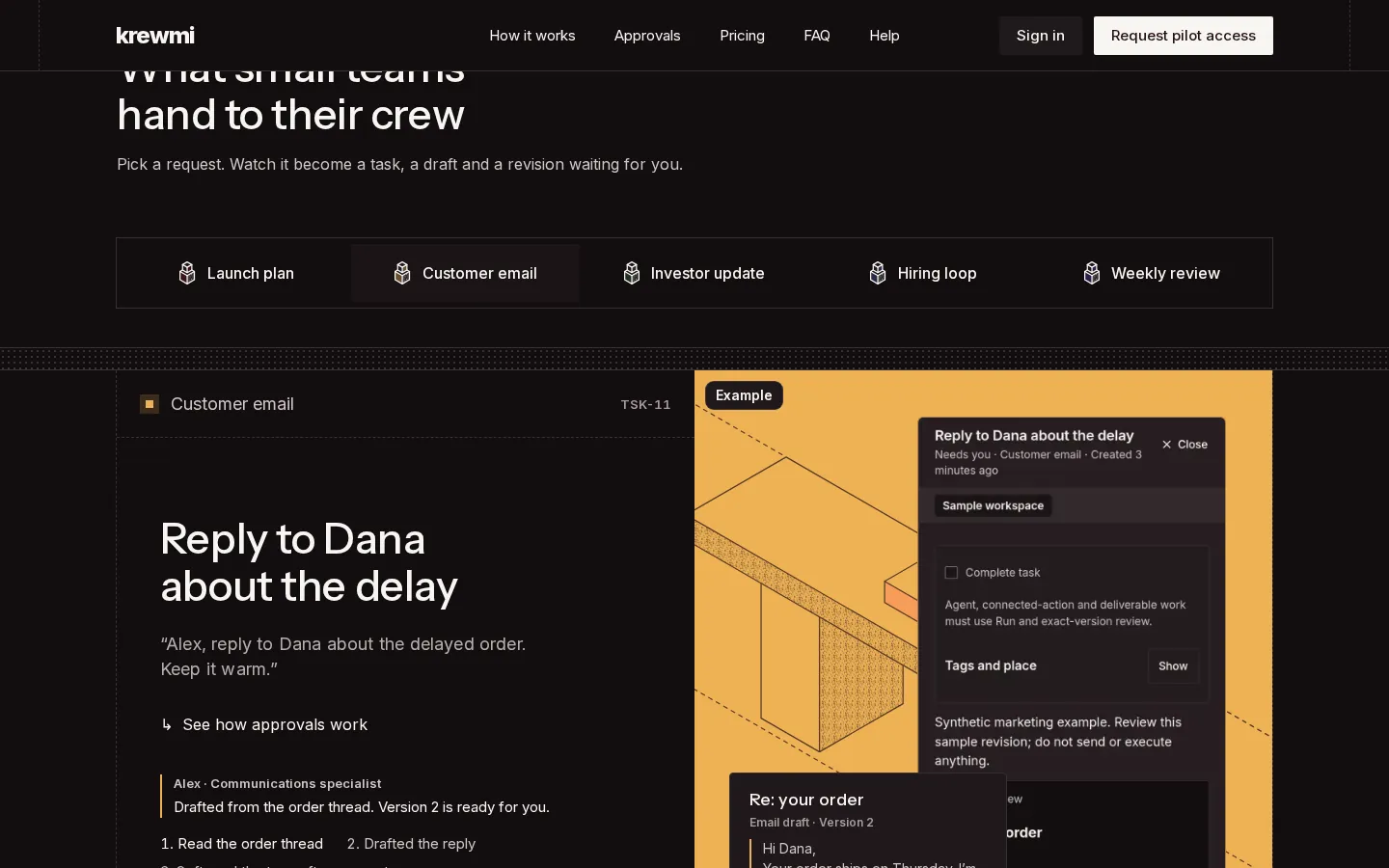
This is the part we cared about most. When Alex drafts the customer email, it does not go out. It waits at Version 2. You approve that exact version, or you ask for changes and a Version 3 appears.
Binding approval to a version matters. If you approve a draft and the agent edits it afterwards, the edited text is a new version that needs its own approval. What you read is what gets sent.
5. The deliverable stays with its history
The approved version becomes the deliverable, stored on the task with the revision it came from. Months later you can still see who asked, who drafted, what changed and who approved it.
Boundaries are part of the design
Krewmi separates three things that most tools blur together:
| Concept | What it means in Krewmi |
|---|---|
| Team title | A label such as CEO, Designer or Assistant. It never grants access on its own. |
| Permission level | Administrator or Worker. Administrators manage the workspace, billing, members and agent access. |
| Soul | An agent's identity, personality and working style, kept separate from its permissions. |
Because a title is not a permission, naming an agent "Head of Finance" does not give it access to the bank. Access is granted on purpose by an administrator.
The same rule applies to outside services. Krewmi connects to Google through a connection the administrator owns, and to GitHub, Linear, Notion, Sentry, Stripe, Neon, Atlassian, Asana and Hugging Face through their official MCP servers, once an administrator connects them.
What small teams hand to their crew
These are the starter use cases we designed and tested against:
- Launch plan. A coordinator splits the launch into steps, drafts a timeline and hands the deck and announcement to teammates.
- Customer email. A communications agent reads the order thread, drafts a reply and softens the tone after your note.
- Investor update. An investor relations agent builds slides from the metrics table and flags any claim it cannot source.
- Hiring loop. The crew sets up interviews with the finalists for next week.
- Weekly review. The crew prepares the weekly review for you to check.
Each one ends the same way: a draft, at a named version, waiting for you.
Why a security team built a coworker product
Raijuna is a security research practice. We spend our time finding the places where software trusts something it should not. When we started using AI agents for our own operations, the obvious risk was an agent with broad access acting on its own judgment.
So we built the controls we wanted to see:
- Approval is required before anything reaches a new recipient.
- Approvals are bound to exact versions, not to a task in general.
- Standing approvals only cover repeat sends to people you already approved.
- Titles never grant permissions.
- Durable work uses database-time fences and immutable command IDs, so a retried step cannot run twice.
Optional TOTP two-factor sign-in is available for workspaces that turn it on.
Technical foundation
Krewmi is a TypeScript monorepo. The web app runs on Next.js, APIs use tRPC for end-to-end types, Better Auth handles sessions, and Neon Postgres stores the workspace. Files are scanned before they are shared.
Availability
Krewmi Release 1 is an invite-only private pilot, watched by an operator. Stripe runs in test mode, so there are no real charges and no public price yet. Public signup opens after legal approval.
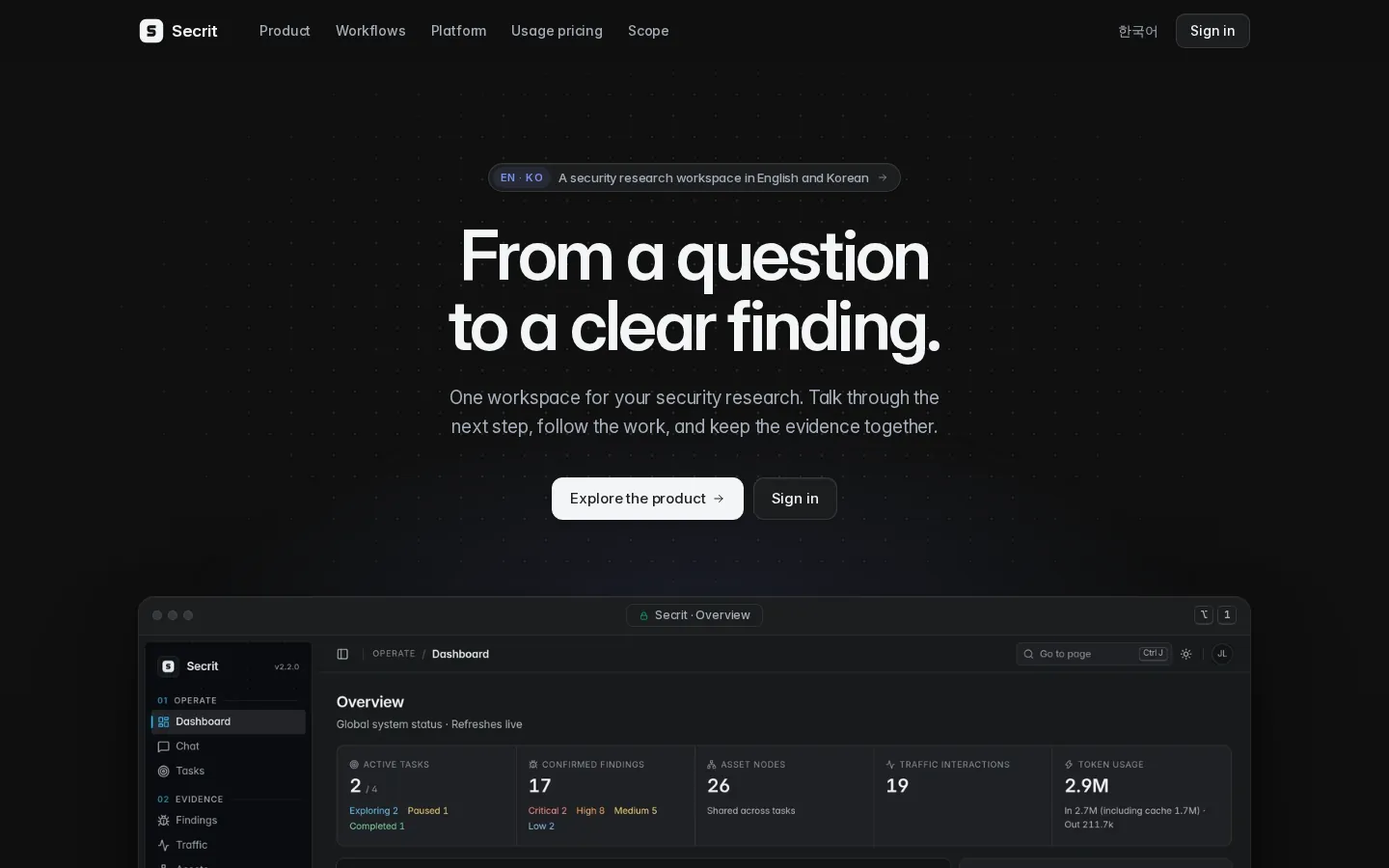
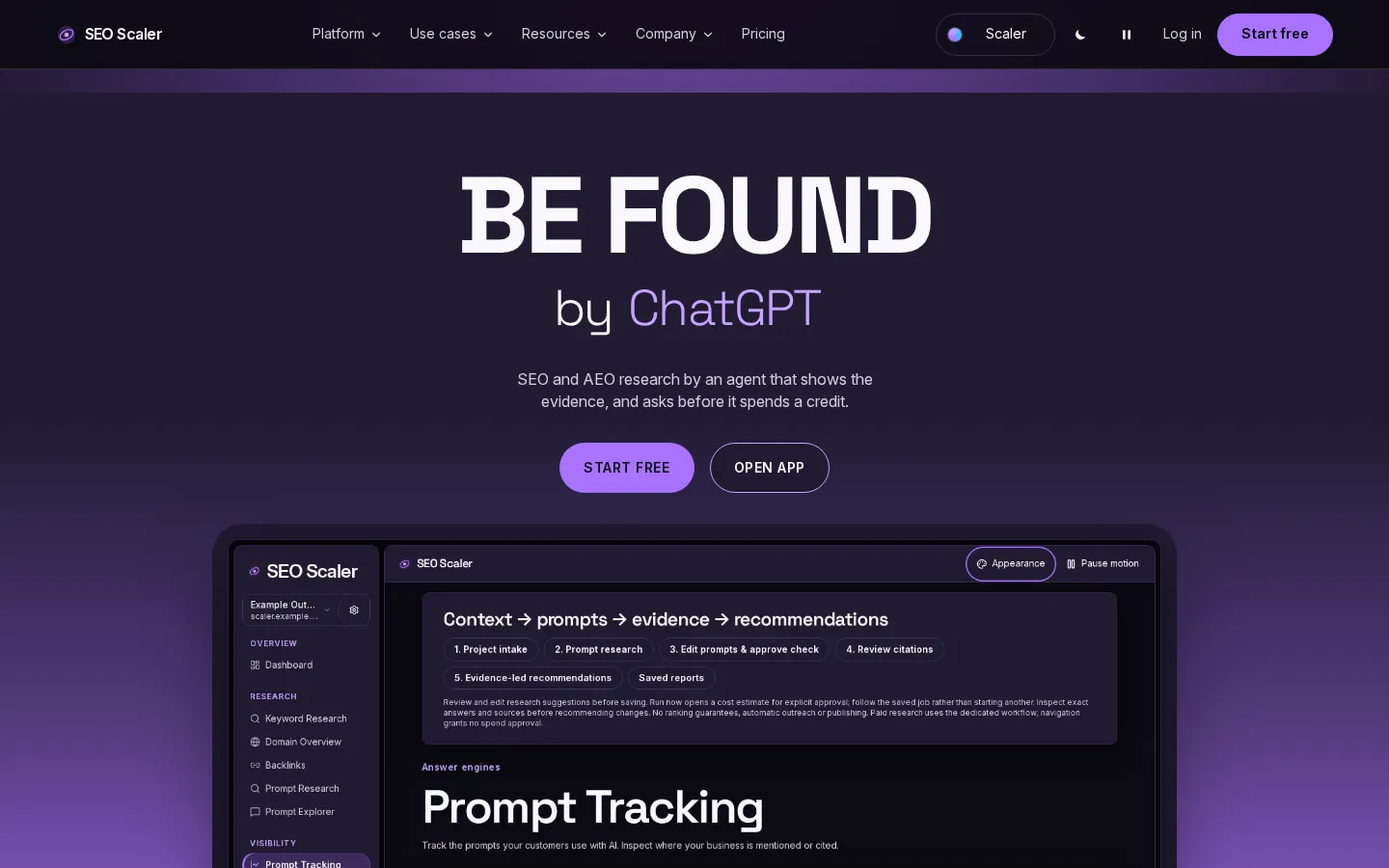
Read the Krewmi product page for the feature list, or see the other products we are launching: Secrit for security research, SEO Scaler for SEO and AI visibility, and Meshsmiths for game-ready 3D assets.